
Sometimes, one of the toughest problems in choosing auricular points is knowing the true cause. While headaches can be complex and involve many different systems of the body, in this post I will provide an overview of how I choose points based on types of headache pain.
Since headaches are often a symptom, not a primary disorder, it’s perfectly okay to choose points that target an anatomical location, such as Shoulder point for tense muscles that run between the neck, upper back, and shoulder blade (the trapezius muscle is one of these, connecting all three areas).
There is ongoing debate about whether headaches are primarily neurological or vascular (caused by an aggravation of the nerves versus circulatory disturbances). Western medicine research has linked vascular headaches to disturbances in the arteries of the neck and those of the brain (Kapoor, 2013). Neurological symptoms of headaches are different, and are usually associated more with migraine. A symptom of a nerve misfiring would include some type of a focal deficit, like blind spots in the vision, or constant tearing of the eyes (Kapoor, 2013).
If a headache persists for more than a few hours, and is very severe, it could be something more serious. A medical consultation may be required to rule out hypertension, diabetes, and other systemic illness.
General Guidelines for Treating Headache
It’s best to start out with just a few points on the ear, rather than too many. Using this diagram, and the pointers for choosing points below (!) you can create a treatment. I use an ear probe or electrical devise to test responsiveness, but if you do not have an ear probe you can use a Q-tip to test points. If your subject has a headache when you do this, you should use light-to-medium pressure in order to avoid triggering more pain.
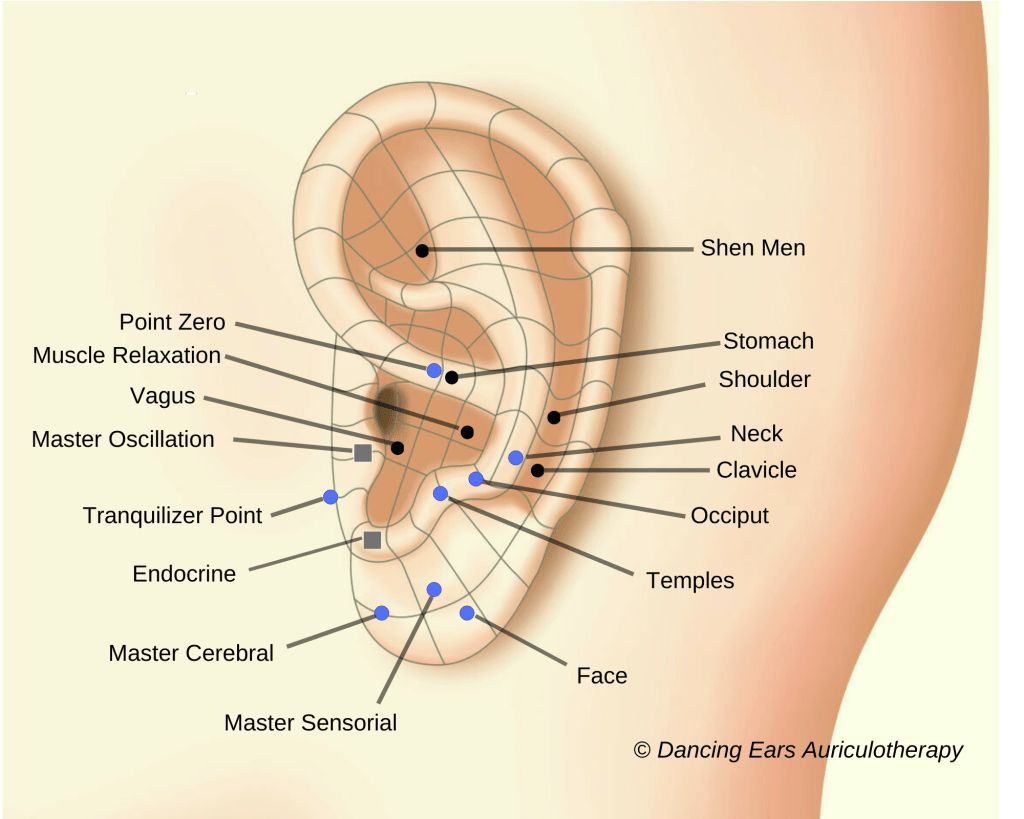
For the purposes of this post, I have narrowed down headaches to the three main types. These are:
- Tension headache
- Sinus headache
- Neck-related headache (dislocated vertebrae or degeneration of cervical spine)
The most common type of headache is tension headache. This is caused by taut muscles of the upper back and neck, especially trapezius, rhomboids and the splenius muscles; skeletal muscles connect cervical (neck) vertebrae to the head (occiput (base of skull) and also connect thoracic spine (upper back) to the head. In this way, tension travels upward towards the head and becomes ischemic (lacking blood flow). I have seen this in my clinic when working with those poor souls who have to stare at computer screens all day. When I worked briefly as a medical transcriptionist I experienced tension headaches first hand; I couldn’t believe the amount of tension in my neck and shoulders after a few hours of intense typing and concentration. Those muscles get rigid and inflexible when held in one position. Another group that suffers are those who drive all day, whether long term (truck drivers) or short term (commuters).
Point Protocols for Three Types of Head Pain
For tension headache, choose Muscle Relaxation, Neck, Shoulder, Occiput and Shen Men. If there is any issue with spinal tension (pain right in the middle of the back on the bony areas) add a point from the musculoskeletal diagram below. (Note that the order goes from high to low starting with the top portion of the ear, so that the lowest part of the spine is the highest as it travels from sacrum to neck).
For sinus headache, choose Master Oscillation, Neck, Occiput, and Shen Men. When applying a pellet for Master Oscillation, I recommend either using a very small Japanese pellet to apply to the underside of the ear (square symbol means it is on the hidden part of the ear), or apply a larger seed or pellet on the outer area opposite the actual point and stimulate by pressing between two fingers. The second way might be easier especially for smaller ears. If there is also pain in the face or cheek, add the Face point.
For neck-related head pain, choose Neck, Clavicle, Occiput, Temples, and Shen Men. Add 1-2 points along the cervical spine; refer to the musculoskeletal chart below. Use the small Japanese pellets for this area.
Variations & Additions:
Vagus: Use this point for very severe headaches that don’t go away on their own. The vagus nerve is connects the subconscious brain to the body, and overstimulation can cause “runaway” symptoms.
Master Cerebral: Use this point when headaches are linked to “overthinking.”
Master Sensorial: Use this point when there are odd sensations like skin crawling, aversion to sounds or light.
Endocrine: Use this point when hormonal changes worsen or precipitate headaches (i.e., onset of menstrual cycle, menopausal issues).
You may wish to add a musculoskeletal point if pain is associated with muscular tension or back pain. For example, neck pain correlates with cervical spine. Low back pain correlates with lumbar spine. And tension between the shoulder blades correlates with thoracic spine (and neck pain since shoulder tension tends to travel or migrate upwards to the head and neck).
Segments of spine are indicated by the number of bullets/shapes. Lumbar spine has five vertebrae, thoracic has 12, and cervical has 7. If you know an exact location of a dislocated or injured vertebrae, you can locate it using this map and you may also use the ear probe. Pain signals do not always conform to such set parameters, however, and it is okay to “ballpark” location. If you don’t see much response, try a different location. Lower back pain can be linked to sacral vertebrae too. And neck and sacral/lumbar issues often go together. I learned about this first in a massage course. When a client has neck tension, you will often find that they also have low back tension. Thus, trying a few points on this map can be helpful.
Musculoskeletal Chart

If you do use the musculoskeletal points, it is best to apply the tiny pellets since these regions on the antihelix are near the edge of this area and won’t react to a large seed or pellet. I recommend the Japanese pellets that are 0.25 mm and can be ordered at the website or other sites online. There is some debate about whether these points are closer to the front or back edge of the antihelix; it is your choice and you can certainly experiment. The inconclusiveness on this anatomical variation was cited in Terry Oleson’s Auriculotherapy Manual. It may be that individual differences have made a final determination difficult, or perhaps that information has been lost over many years of time.

For reference, this image shows the group of shoulder muscles that are typically the culprits in tension headaches
REFERENCES
Kapoor, S. (2013). Headache Attributed to Cranial or Cervical Vascular Disorders. Current Pain and Headache Reports, 17(5), 334. doi: 10.1007/s11916-013-0334-y
Silberstein, S. D., Young, W. B. (2004). Migraine and other headaches. New York, NY: Springer Publishing Company.
 Channel Acupuncture & Herbs