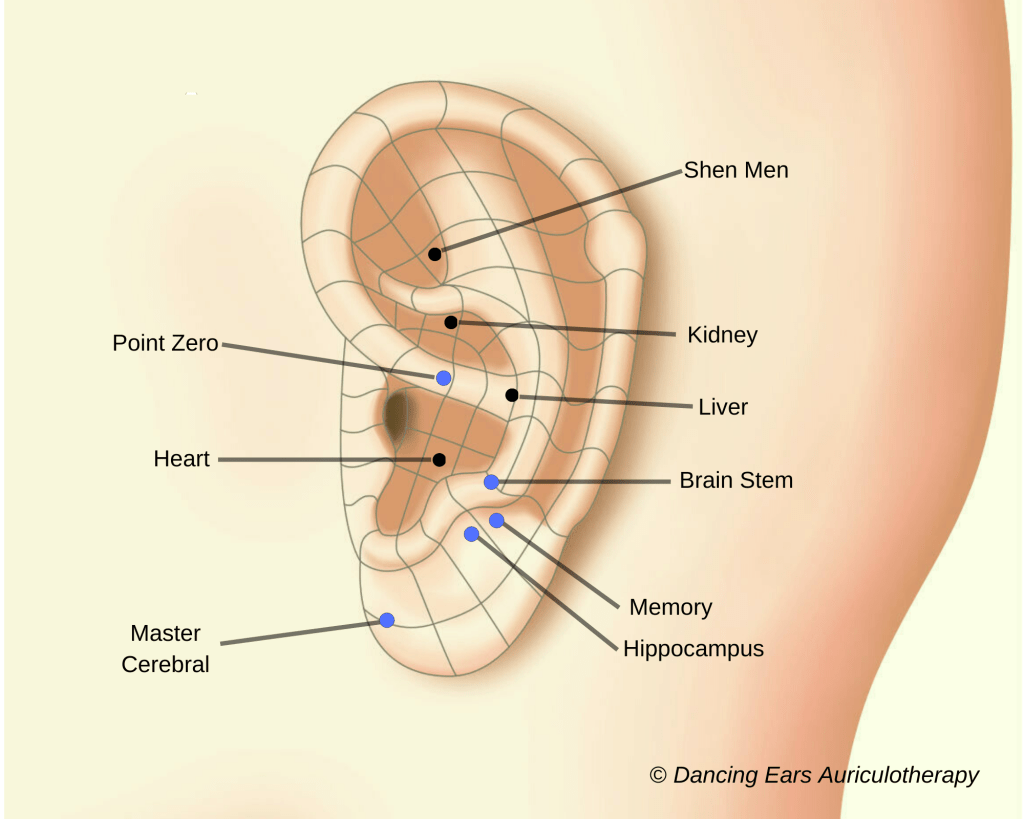
Ear seeds and ear massage can help with pain, immune system regulation, vision, hearing, and more. One of the most fascinating and unknown uses for auriculotherapy is for a range of issues that affect neurological and psychological pathways, like memory loss, ADD/ADHD, seizures, depression, aphasia, and sensory issues.
Auricular pathways and their link to the brain have been recognized by medical researchers who have developed protocols to help in the treatment of addictions, migraines, and other complex issues (Liebell, 2019). Ear medicine is also used as an adjunct to conventional pharmaceutical and behavioral interventions for ADD/ADHD, memory loss and even traumatic brain injury.
AURICULOTHERAPY FOR BALANCING THE BRAIN
ADD/ADHD
Studies show that there is a high statistical variance in the right hemisphere of ADD or ADHD such that there is asymmetry between the right and left hemispheres as compared with neurotypicals. The right hemisphere is linked with creative and imaginative capacities as well as holistic thinking, and the left brain is more analytical, logical, and geared towards systematic processes like those involved in math or science (Guy-Evans, 2013).
It has been noted that the right prefrontal and frontal cortex are not as responsive in persons with ADD/ADHD. This variance accounts for high levels of distractibility and hyperactivity. The main fallout of this phenomenon is the commonly reported issues of trouble making decisions, sensitivity to outer noises or overwhelm due to multiple streams of auditory or visual stimuli, and issues with initiating tasks.
Auricular points that regulate transmission of sensory and motor information between the hemispheres, and the brain stem, have been found to improve scores on tasks involving language and spatial recognition (Helfer, Maltezos, Liddle, Kuntsi & Asherson, 2020).
Stimulus on the ear with a handheld device that emits carefully calibrated electrical frequencies was first researched in Europe, and used to both test and treat areas on the ear that show reflex arcs to the brain. There are dozens of points that affect transmission of energy and communication between the brain and body. Some of the main ones used for ADD/ADHD are corpus callosum, thalamus and brainstem.
An example auricular protocol for ADD/ADHD includes:
- Thalamus relays sensory information between the lower and higher brain, or brain stem and cerebral cortex. Its functionality impacts our conscious perception of pain and also emotional states.
- Corpus callosum is the band of nerve fibers that links the right and left hemispheres. It is crucial for adaptive learning and many motor and language functions. Auricular stimulation assists with learning and behavioral problems.
- Brainstem is the area for unconscious postures and conditioned reflexes. This auricular point influences baseline rates of breathing, blood pressure and heart rate.
- Accessory points to calm nerves can be added, for example, Shen Men, Tranquilizer, Occiput and Neurasthenia.
MEMORY/CONCENTRATION
Memory deficit can occur for many reasons ranging from PTSD and post-viral illness to post-concussion syndrome and dementia. The left brain is responsible for memory of verbal instructions and the right brain is responsible for non-verbal memory; so, using the ear opposite to this directional bias yields the best result.
The hippocampus is involved in declarative or conceptual memory or remembering an event that has happened only once (Traub, 1991). It is linked to transient amnesia whereby a person can not recall anything for a few minutes and asks the same questions over and over.
The cerebellum is key to procedural memory, that is, remembering a skill learned through practice like throwing a baseball or driving a car.
Some cases of amnesia are more complex involving gaps in memory, affecting the loss of either old or new memories. Sometimes the memory loss is transient and only lasts a few hours. Areas of the limbic brain are important to assess and stimulate in such cases, for example, thalamus, hippocampus, and amygdala.
SELF CARE FOR BRAIN BALANCE
Since the limbic system is the main area of the brain linked with memory, rubbing the anterior ear closest to the face as well as the earlobe is a great self-help technique. Use your index or middle finger to stroke the anterior ear 5-10 times. Stretch and squeeze the earlobe front to back at least ten times to stimulate the cerebral cortex.
REFERENCES
Liebell D., (2019). The science of auricular microsystem acupuncture: Amygdala function in psychiatric, neuromusculoskeletal, and functional disorders. Medical Acupuncture, 3:157-163. doi: 10.1089/acu.2019.1339.
Traub, R. D. & Miles, R. (1991). Neuronal networks of the hippocampus. United Kingdom: Cambridge University Press.
Guy-Evans, O. (2023). Lateralization of brain function and hemispheric specialization. Retrieved from https://www.simplypsychology.org/brain-lateralization.html
Helfer, B., Maltezos, S., Liddle, E., Kuntsi, J, & Asherson, P. (2020). Lateralization of attention in adults with ADHD: Evidence of pseudoneglect. European Psychiatry. 63(1). Retrieved from https://www.ncbi.nlm.nih.gov/pmc/articles/PMC7443776/
RESOURCES
Huang, Li-Chun (2005). Auricular medicine: The new era of medicine & healing. Auricular International Research & Training Center.
To order ear seeds or crystals, and downloadable protocols for various health issues visit my Etsy store: https://www.etsy.com/shop/DancingEarsDesign
If you have any questions about the use or application of auriculotherapy please use the contact form on the website. I often offer free one-on-one tutorials using an ear model to illustrate how to apply and locate points on yourself or others.
 Channel Acupuncture & Herbs